Filtering Transactions

You can filter HTTP Monitoring data by HTTP Host, HTTP method, Host, Runtime, and Application. You can use those filters individually or combined:
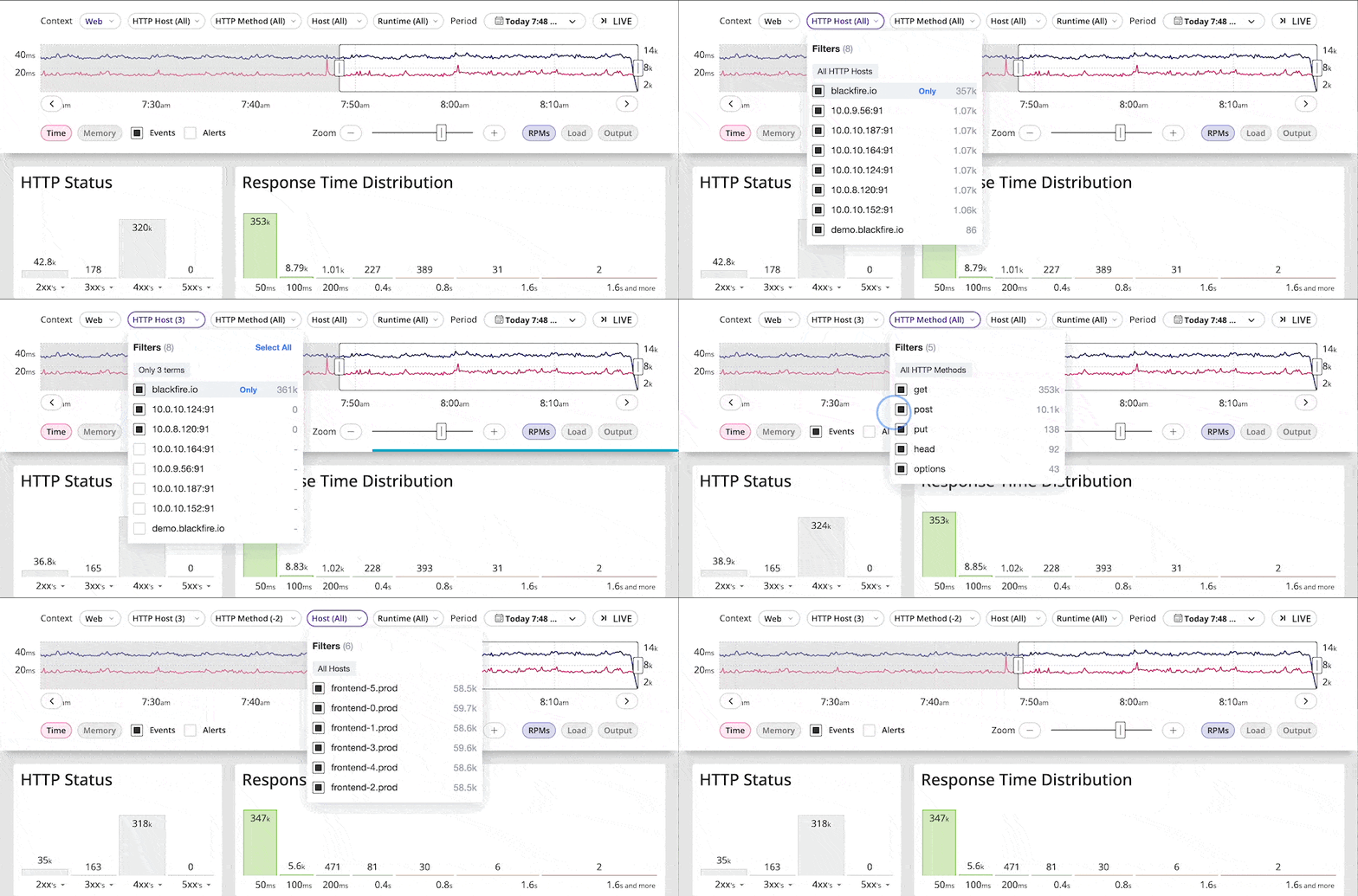
Each filter allows you to pick only some terms, or everything but some terms.
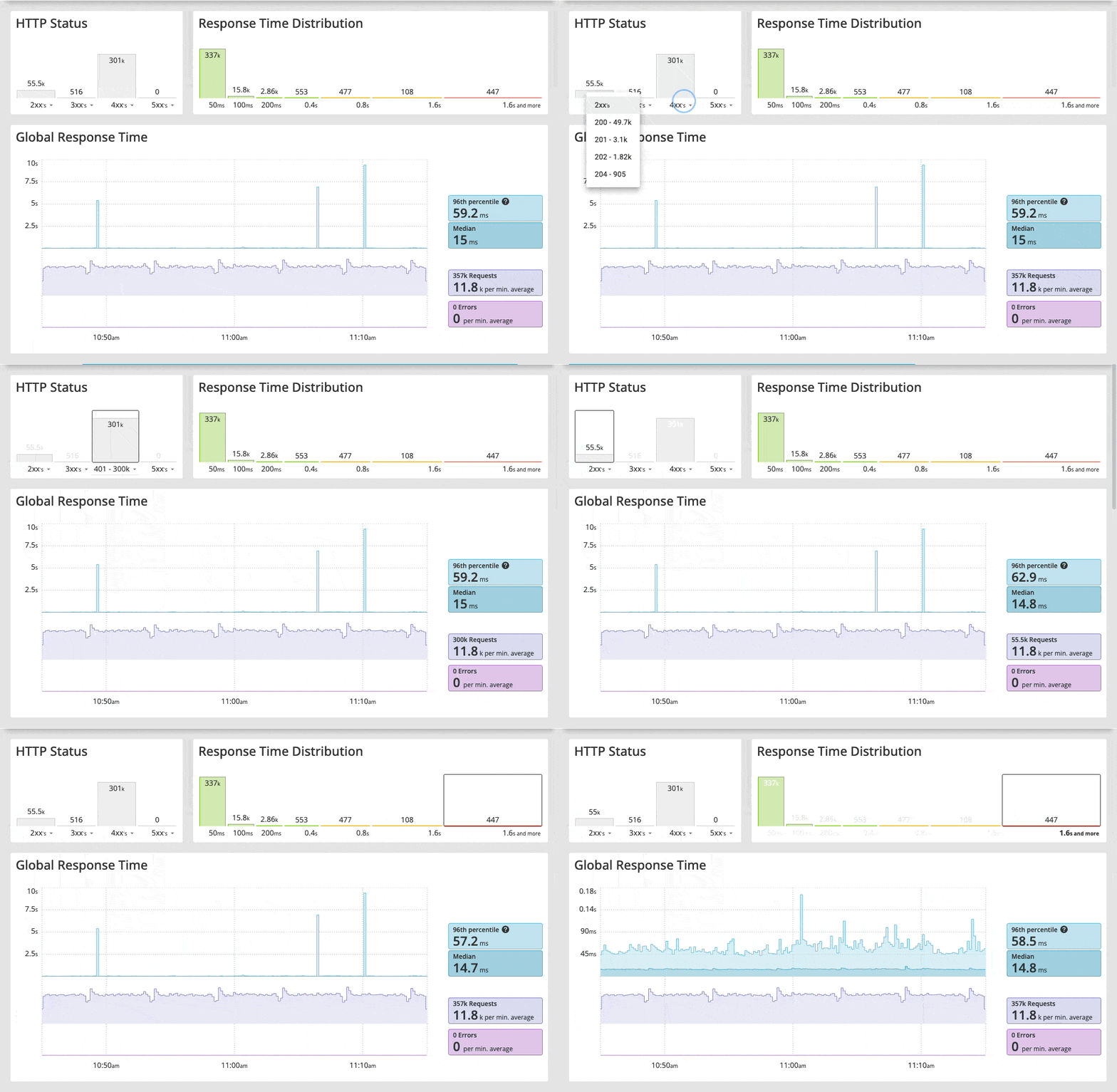
You can concomitantly filter monitoring data by HTTP status or response time by clicking the respective graph. To reset the filter, click the graph again:
Filtering by application

When several applications report to the same environment, you can restrict the Monitoring dashboard to one or more of them with the Applications filter, located above the main graph.
Like the other filters, the Applications filter lets you select Only some applications, or All applications except some. It combines with the HTTP host, HTTP method, host, and runtime filters.
Transactions sent without an application name are grouped under Default.
The Applications filter appears only when the selected timeframe contains monitoring data with an application name.
Setting the application name

The application name is supported by PHP Probe 2026.4.1 or later, and
Python SDK 2026.4.0 or later. Other runtimes and older versions report their
transactions under Default.
On Upsun, PHP and Python applications report their own name without any configuration.
Elsewhere, set the application name for PHP with the blackfire.app_name INI
setting:
1
blackfire.app_name = my-apiTo set a different name per PHP-FPM pool, define the setting in the pool configuration:
1
php_admin_value[blackfire.app_name] = my-apiYou can also set the BLACKFIRE_APP_NAME environment variable. For Python,
this is the only option. For PHP, the Probe reads BLACKFIRE_APP_NAME once,
when PHP starts. Set it in the environment of the PHP-FPM master process or of
the CLI command, for instance in a Docker image or a systemd unit.
PHP-FPM env[BLACKFIRE_APP_NAME] pool directives have no effect: the
Probe reads the environment before PHP-FPM applies them. Use
php_admin_value[blackfire.app_name] instead.
Top Transactions


The Monitoring Dashboard displays the list of top transactions for the selected timeframe. This list is primarily sorted by impact, representing the percentage of time spent processing one transaction versus all the other ones.
A best practice is to optimize high impact transactions first.
You can also sort the top transactions list by number of requests, response-time, 96th percentile, memory, and errors.
To display the monitoring data related to a transaction, click the transaction name.
The Top Services tabs displays the most impactful spans for the whole environment.
Transaction Breakdown

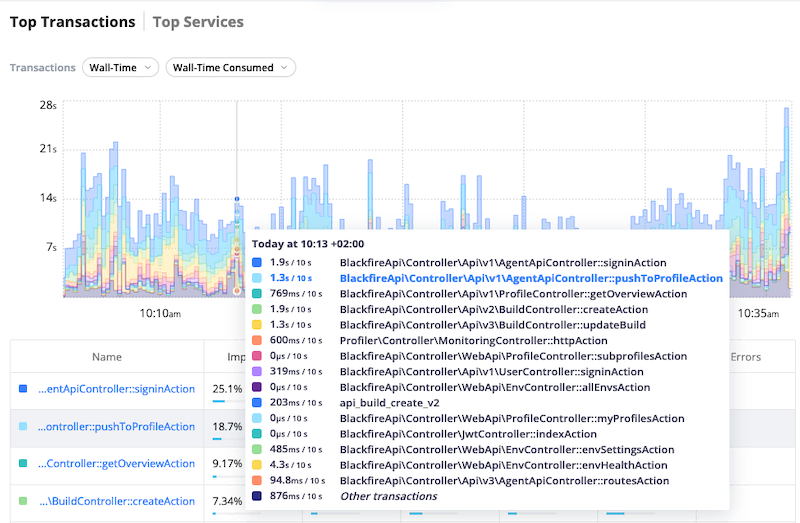
The transaction breakdown graph displays the evolution of the most impactful transactions over time, for the selected timeframe and dimension. It provides convenient contextualized information, helping you understand your application's dynamics.